






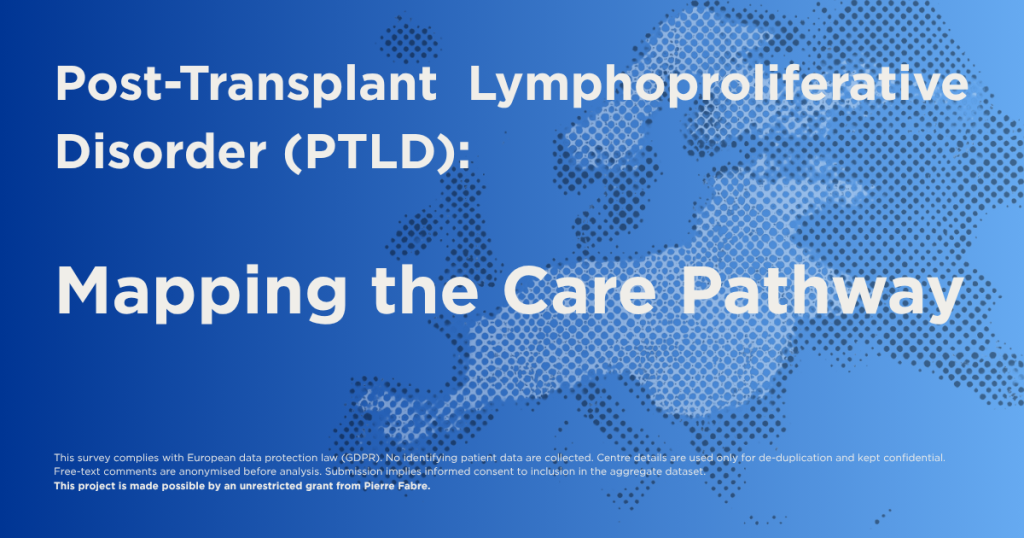
Practice in EBV-positive post-transplant lymphoproliferative disorder (PTLD) varies widely between centres. Yet PTLD remains an uncommon and serious complication following solid organ transplantation.
To build a clearer picture of how these patients are cared for in real-world settings, we are launching a European survey to map the current PTLD care pathway.
Led by Sophie Caillard (CHRU Strasbourg) and Daan Dierickx (UZ Leuven), the survey explores the full pathway of care, including:
- pre-transplant EBV risk assessment;
- viral load monitoring;
- diagnosis;
- reduction of immunosuppression;
- first- and second-line treatment; and
- the interface between transplant and haematology teams.
Who should take part?
We would particularly value the contribution of transplant physicians and haematologists involved in the care of patients with EBV-positive PTLD following solid organ transplantation.
The aim is to understand what happens in routine clinical practice across European centres. Respondents should therefore answer according to their own centre’s usual practice, rather than what guidelines recommend.
The survey uses role-based routing, meaning you will only be asked questions relevant to your professional role.
Please note that the survey concerns EBV-positive PTLD following solid organ transplantation only. PTLD occurring after haematopoietic stem cell transplantation should not be included.
Estimated completion time: 15–25 minutes.
PTLD across Europe: help us map the reality of care.
Take the survey:
https://go.esot.org/SP_PTLD2026
Your contribution will help ESOT develop a clearer picture of current PTLD practice across Europe and will inform future educational and research activities. Results are intended for publication in aggregate form.
This survey complies with European data protection law (GDPR). No identifying patient data are collected. Centre details are used only for de-duplication and kept confidential. Free-text comments are anonymised before analysis. Submission implies informed consent to inclusion in the aggregate dataset.
This project is made possible by an unrestricted grant from Pierre Fabre.