







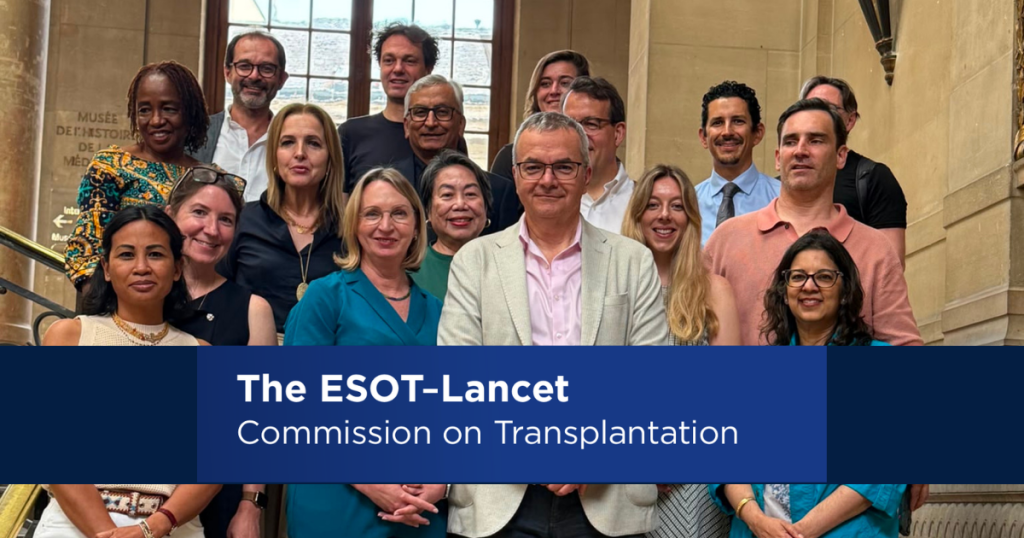
The ESOT-Lancet Commission on Transplantation met this week in Paris for a structured working session dedicated to advancing its vision for the future of global transplant health.
Launched in July 2025, the Commission brings together leading international experts to develop a new vision for sustainability, innovation and equity in organ transplantation. Its ambition is to reposition transplantation not as a niche intervention, but as a strategic health system function aligned with global priorities, including non-communicable diseases, climate resilience, pandemic preparedness and health system sustainability. The meeting represented an important step in the Commission’s development, moving from the conceptual phase towards a more operational and actionable framework.
Over two days, commissioners engaged in focused discussions around accessibility, innovation, system redesign and new models of collaboration. The conversations were rich, constructive and, at times, deliberately thought-provoking, helping to challenge assumptions and refine the direction of the work ahead.
At the centre of the meeting was a fundamental question: how can innovation, system redesign and new models of collaboration improve global accessibility to transplantation?
For too long, transplantation has often been assessed primarily through activity-based measures, such as the number of transplants performed, donor rates and waiting lists. While these indicators remain important, they do not fully capture whether patients who need transplantation can truly access it. A country may have active transplant programmes and still provide poor access to many patients across different regions, communities or stages of the care pathway.
As Elmi Muller, Co-Chair of the Commission, reflected: “For too long, transplantation has been measured primarily by activity – numbers of transplants performed, donor rates and waiting lists. Yet a country may have active transplant programmes and still provide poor access to many patients who need them. Our discussions are therefore focused on accessibility across the entire patient journey: diagnosis, referral, assessment, waitlisting, transplantation and long-term follow-up. We are examining where barriers arise, why they persist and how they can be overcome. A particular focus is understanding transplantation through the lens of equity.”
This emphasis on equity, sustainability and implementation was echoed by Gabriel Oniscu, Co-Chair of the Commission and ESOT Past President, who shared: “Engaging, informative and thought-provoking discussions are helping shape how we think about the future of transplantation globally. Technology and innovation will play a crucial role in levelling global differences, but only if they are guided by equity, sustainability and real-world implementation.”
The meeting also reinforced the importance of collaboration across disciplines, regions and health systems. The Commission is working to ensure that diverse global perspectives, patient experience, empirical data, case studies and expert consensus inform its recommendations.
Reflecting on the progress made in Paris, Chloe Wilson, The Lancet Editor assigned to the project, said: “It has been a pleasure working with such a dedicated group on The Lancet Commission on Transplantation. Our meeting in Paris has been an important opportunity to align around a shared vision for more accessible and innovative transplantation care. While much remains to be done, I am delighted by the progress we have made so far.”
The ESOT-Lancet Commission on Transplantation will continue its work towards the development of practical recommendations, measurable indicators and a roadmap for implementation. Its ultimate aim is to help shape a future in which transplantation is not a privilege, but a sustainable, equitable and universal part of healthcare.
ESOT extends its sincere thanks to all the commissioners who contributed their insight and commitment to this important meeting – and to the people working behind the scenes to make this ambitious collaboration possible.
The work continues – towards a more sustainable, innovative and equitable future for global transplant health.