Some courses stay with you long after the final session ends.
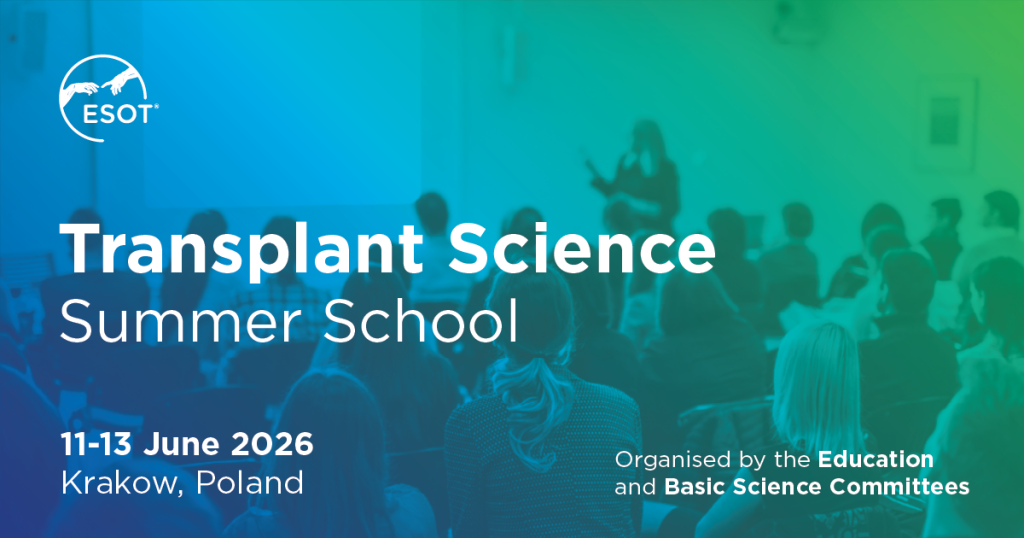
The first edition of the ESOT Transplant Science Summer School, held in Kraków, was one of those moments.
Over 2,5 days, 30 young transplant professionals from 14 countries came together with faculty, patient representatives, and ESOT leaders to explore the science shaping the future of transplantation. More than 20 lectures, interactive sessions, group work, and open discussions created a programme that was rich not only in knowledge but also in energy, curiosity, and connection.
From the very beginning, it was clear that this was not just a series of lectures. Participants arrived ready to ask questions, challenge ideas, share perspectives and look beyond their own disciplines. The conversations moved from translational medicine, immunosuppression and ischaemia–reperfusion injury to machine perfusion, biomarkers, immunology, xenotransplantation, artificial intelligence and clinical trial design. Just as importantly, they learned how close science and clinical practice are connected to ultimately benefit patients.
What made the Summer School special was the diversity in the room. Clinicians, scientists and researchers brought different backgrounds, experiences and ways of thinking. Faculty members offered not only expertise, but mentorship and openness. Together, they created an atmosphere where knowledge was shared, and learning was practical and alive.
One theme returned throughout the course: transplantation advances through teamwork. Progress does not happen in isolation. It happens when clinicians, scientists, surgeons, immunologists, engineers, coordinators, patients and many others interact and work towards the same purpose. This spirit of collaboration and building connections across disciplines was at the heart of the Summer School.
Keeping the patient at the centre of the conversation was equally important. In a programme filled with cutting-edge science, the patient perspective reminded everyone why this work matters. A dedicated keynote session on patient participation in transplantation research, with contributions from Penilla Gunther and Mehreen Ahmed, offered powerful reflections on the importance of involving patients not as an afterthought but as essential partners in research and innovation.
We feel that many participants left Kraków with fresh ideas, new perspectives on their projects and renewed motivation for their future work. Faculty members, too, described the experience as deeply inspiring. The engagement, generosity and curiosity of the participants gave real meaning to the purpose of the Summer School: to support the next generation of transplant professionals and help build a community that continues beyond the course itself.
This first edition was organised through a close collaboration of the ESOT Education Committee, chaired by Liset Pengel, and the ESOT Basic Science Committee, chaired by William Scott, whose committee shaped the outstanding scientific programme. It reflected the vision and dedication of many people across ESOT, including contributing sections and committees, faculty members, patient representatives and the ESOT Leadership.
We gratefully acknowledge the support that helped make this educational initiative possible. The course was supported via an unrestricted educational grant by Astellas. The Annual Partner of the Machine Perfusion Track 2026 is Bridge to Life, and we also acknowledge the support of CareDx.
The first ESOT Transplant Science Summer School showed what can happen when science, education, mentorship and community come together with a shared purpose. New ideas were sparked. Networks were built. Future collaborations began to take shape.
Above all, it reminded us that investing in early-career professionals is one of the most meaningful ways ESOT can give back to its community and, through that community, to the patients at the centre of everything we do. The programme was built around the educational needs identified by our community, ensuring that what was taught reflected what transplant professionals truly needed.
This was only the beginning.
See you at the second edition.